MKTG 725 · Darla Moore School of Business · University of South Carolina
AI in Marketing: The Living Textbook
A seven-chapter guide to how artificial intelligence is changing the way brands understand, reach, and serve customers. Each chapter opens with a real case from the news, explains the ideas behind it, and is updated twice a week, because a printed textbook on AI is out of date before it ships.
By Dr. Ayse Ozturk · Fall 2026 edition · Last updated October 4, 2026

Why this textbook
Built for a field that changes every week
Most marketing textbooks treat AI as a closing chapter. This one puts it at the center and keeps it current.
Real cases, not hypotheticals
Every chapter opens with a recent case from well-known brands, from McDonald’s drive-thru AI to Amazon’s fight with shopping agents.
Every claim sourced
Facts, numbers, and quotes link to the original source, with a full APA reference list in each chapter. Company-reported figures are labeled.
Practice built in
Flashcards, a ten-question quiz, a judgment exercise, and discussion questions with model answers close every chapter.
Updated twice a week
Every Monday and Wednesday, a “Latest updates” box in each chapter adds new research, rulings, and launches.
The course at a glance
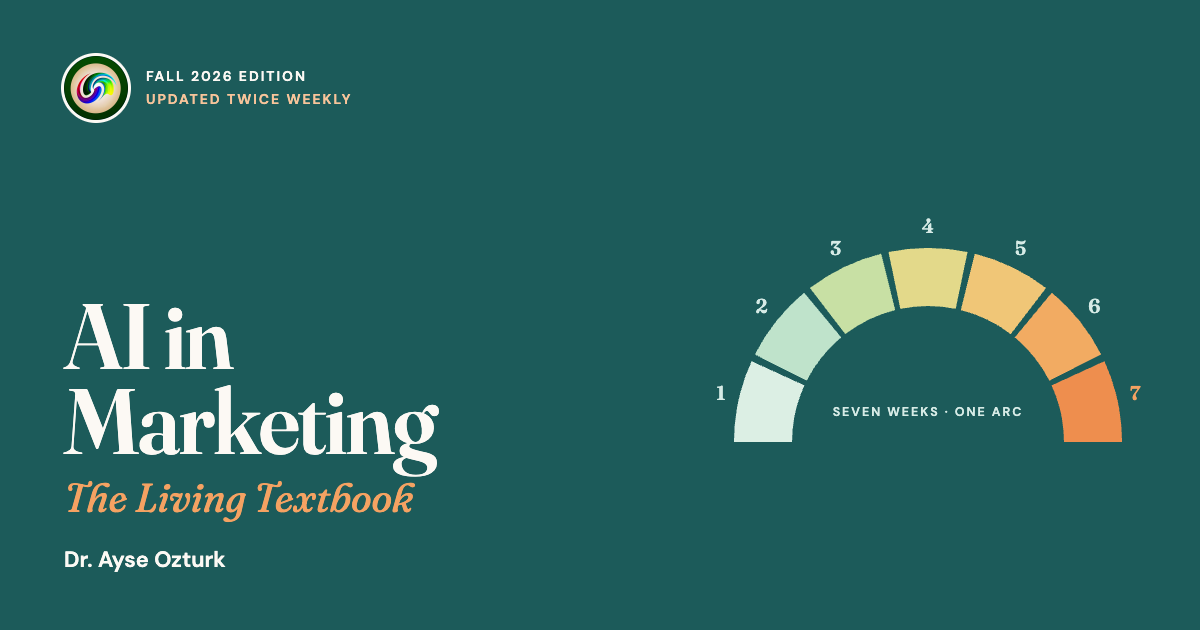
Seven weeks, one arc
The chapters build on each other: understand the technology, create with it, reach customers, automate, learn from data, govern it, and then put it all to work in an audit of a real company.
Chapters
Read the chapters
Chapter 1 is a sample chapter. Chapters 2–7 are password-protected for students enrolled in MKTG 725.
Foundations of AI and Marketing
In this chapter- What AI is, and what it is not
- How large language models produce text
- The jagged frontier: where AI helps and where it fails
- Why marketing has always been a prediction business
Opening case: Would you like AI with that? Inside the drive-thru test
Read the free chapter →Generative AI and Content Marketing
What generative AI can make, how to prompt like a creative director, and why “made with AI” can cost a brand trust.
Opening case: Made by machines, judged by people
Read chapter →Personalization, SEO to GEO, and Retailing
Personalization at scale, the shift from search rankings to AI answers, and agentic commerce in retail.
Opening case: Amazon shut the door. Shopify opened one.
Read chapter →Marketing Automation, Workflows, and Agents
From single prompts to workflows to AI agents, the connectors behind them, and where people must stay in charge.
Opening case: The agent that did 700 jobs, and the one that gave away a PlayStation
Read chapter →Marketing Research, Segmentation, and Predictive Analytics
Predictive models, AI segmentation, synthetic data, and digital twins, and how to tell a good prediction from a flattering one.
Opening case: The focus group gets a digital twin, then an audit
Read chapter →Strategy, Implementation, Ethics, and Future Trends
Turning pilots into value, governing AI, and managing hallucinations, bias, copyright, and privacy, plus the skills that matter next.
Opening case: When AI gets it wrong, the brand pays
Read chapter →Review and Term Project: The AI Marketing Audit
One framework for the whole course and a step-by-step guide to auditing a real company’s marketing with AI.
Opening case: Strategy is what you say, too: Duolingo’s “AI-first” memo
Read chapter →Study guide
How to use this textbook
Before class
Read the chapter for the coming week and watch at least one of its videos. The weekly quiz draws on the lecture and the readings.
After class
Work through “Check your understanding,” then try “Apply it.” Each one builds a piece of your AI Marketing Audit.
Twice a week
Check “Latest updates” at the end of each chapter on Mondays and Wednesdays. That is where new developments land first.
Companion resources
Your toolkit
Free resources from Dr. Ozturk’s site that go with every chapter.

About the author
Dr. Ayse Ozturk
Dr. Ayse Ozturk is an Assistant Professor of Marketing at the Darla Moore School of Business, University of South Carolina. Before academia she worked at PricewaterhouseCoopers, Deloitte, and Peugeot. Her research on artificial intelligence, marketing strategy, international marketing, and sustainability appears in the Journal of International Business Studies, International Business Review, and Thunderbird International Business Review. She designed and teaches the MBA course AI in Marketing and leads AI workshops for faculty and professionals in the U.S. and Canada.
Editorial standards
How this textbook is built
Sourcing
Peer-reviewed research, university studies, leading business publications, and regulators come first; trade press only when no stronger source exists. Company figures are labeled as company-reported.
Verification
Every number, quote, author, and date is checked against the original source before it appears. If something cannot be verified, it is left out.
AI use
Chapters are drafted with the help of AI tools and reviewed, edited, and approved by Dr. Ozturk. Articles are summarized and linked, never reproduced.
Corrections
Spot an error or a broken link? Email ayse.ozturk@moore.sc.edu. Some sources require a subscription, which USC Libraries can often provide.
How to cite this textbook
Cite the textbook or the chapter you used, with the date you accessed it, because the pages are updated continuously. In-text citation: (Ozturk, 2026). For a specific fact or statistic, cite the original source listed in the chapter’s references.
The whole textbook (APA 7)
Ozturk, A. (2026). AI in marketing: The living textbook. Retrieved [Month Day, Year], from https://drayseozturk.org/ai-in-marketing-textbook/
A single chapter (APA 7), for example Chapter 1
Ozturk, A. (2026). Foundations of AI and marketing (Chapter 1). In AI in marketing: The living textbook. Retrieved [Month Day, Year], from https://drayseozturk.org/ai-in-marketing-textbook/chapter-1-foundations/
For instructors
Instructor resources
Teaching with this textbook, or considering it for your course? Instructor resources are available, including an instructor guide with a seven-week plan, session plans, in-class activities, and notes for leading the discussion questions. Please get in touch with Dr. Ozturk to obtain them.
Or email ayse.ozturk@moore.sc.edu.
Accessibility
Accessibility statement
This textbook is built to work for every reader, including people who use a screen reader, a keyboard instead of a mouse, screen magnification, or captions. The goal is WCAG 2.2 Level AA, the current W3C standard. Meeting it also meets WCAG 2.1 Level AA, the standard named in the University of South Carolina’s digital accessibility initiative.
What is in place
- Every figure and chart has a text description, and headings, lists, and tables are marked up so screen readers can navigate them.
- Text and background colors meet WCAG AA contrast.
- The flashcards, practice quizzes, and judgment exercises work with a keyboard alone (Tab, arrow keys, and Enter), and quiz feedback is announced to screen readers.
- Pages reflow on narrow screens; wide tables scroll inside their own frame.
- Card flips and other animations stop when your device is set to reduce motion.
- Videos play in YouTube’s player, where the CC button turns on captions; each video also links to its YouTube page.
- Links to outside sources open in a new tab.
Known limits
- Cited articles and videos live on other websites, some behind paywalls, and their accessibility is outside this site’s control.
- The site theme and the embedded YouTube player are provided by WordPress.com and YouTube.
Last reviewed October 4, 2026, with automated testing (axe-core) and keyboard testing.
Copyright and terms of use
© 2026 Dr. Ayse Ozturk. All rights reserved.
Brief quotations with full citation are welcome. Any other copying, adaptation, or redistribution requires written permission: ayse.ozturk@moore.sc.edu.